


MMM vs Marketing Analytics: What's the Difference, and When Do You Need MMM?

Marketing mix modeling and marketing analytics get used as if they were the same thing, and that mix-up costs companies time and money. I've never walked into a company and thought, "The problem is they don't have enough reports." What matters is matching the tool to the question. A pile of dashboards will not answer a budget question, and an expensive model will not rescue tracking nobody trusts.
Here is the short answer to MMM vs marketing analytics. Marketing analytics is the whole discipline of measuring marketing: tracking, dashboards, attribution, testing, customer analysis, and forecasting. Marketing mix modeling, or MMM, is one specific statistical method inside that discipline, built to answer one big question: how should we split the budget across channels? Every company needs marketing analytics. MMM is worth adding once your analytics are solid and your budget spans enough channels, and once both are in place, each one makes the other more accurate. That full picture, analytics plus modeling, is how I set up marketing mix modeling and analytics for clients.

1. What is marketing analytics?
Marketing analytics is the umbrella. It covers everything you do to measure what marketing is doing and decide what to do next. In practice it has six parts.
The first is tracking: GA4, tag management, conversion events, UTMs, and the connection between your ad platforms and your CRM or ecommerce system. The second is reporting, meaning the dashboards and KPIs your team reviews every week. The third is attribution, the rules for assigning credit for a conversion to the touchpoints before it. The fourth is testing, from simple A/B tests on landing pages to incrementality experiments such as geo holdouts and conversion lift studies that show what a channel actually adds. The fifth is customer analytics: segmentation, churn, retention cohorts, and lifetime value. The sixth is forecasting, projecting revenue, leads, or demand so you can plan.
Most of this runs daily or weekly. It tells you what happened, where things broke, and what to fix this week.
2. What is marketing mix modeling, and where does it fit?
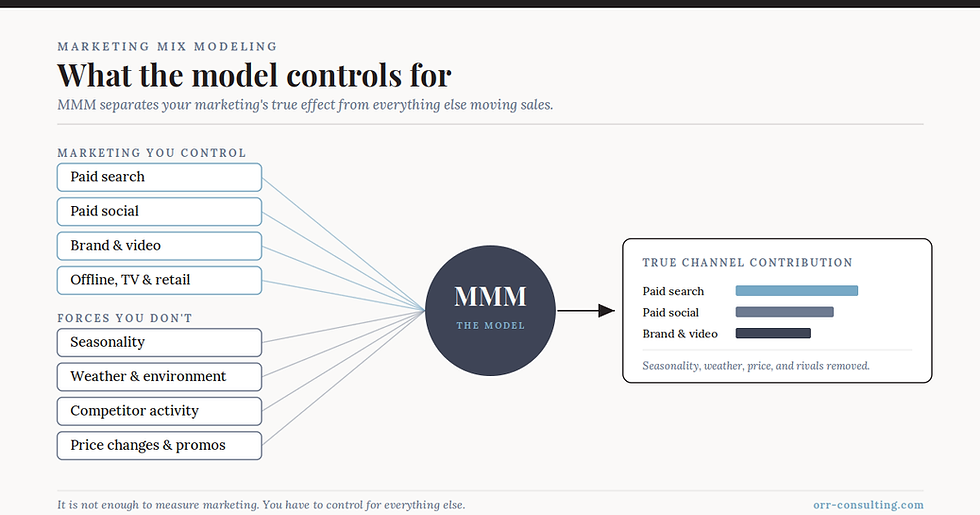
Marketing mix modeling is a statistical method that uses two to three years of aggregated weekly data, your spend by channel, your sales, and outside factors like seasonality, pricing, promotions, and the economy, to estimate how much each channel truly contributed to revenue. It does not follow individual users, so it works even when cookies and tracking fall short. If you want the full primer, including carryover and diminishing returns, start with marketing mix modeling, explained.
MMM sits inside marketing analytics as its strategic budget tool. Your dashboards and attribution reports run the day-to-day. The MMM answers the bigger, slower questions: which channels are saturated, which ones are taking credit for demand that already existed, and where the next dollar should go. I wrote separately about how MMM compares with attribution specifically in marketing mix modeling vs. attribution. This post is about the wider picture, the whole analytics function and where MMM belongs in it.
3. How do MMM and marketing analytics compare side by side?
The easiest way to see the difference is to line up what each one is for.
Marketing analytics | Marketing mix modeling | |
|---|---|---|
Main question | What happened, where did it break, and what should we fix this week? | How much did each channel really contribute, and how should we split next year's budget? |
Typical outputs | Dashboards, KPIs, funnel reports, test results, churn and segment analysis, forecasts | Channel contribution, ROI by channel, response curves, saturation points, budget scenarios |
Data needed | Event-level tracking, ad platform data, CRM or ecommerce data | Two to three years of weekly spend by channel, revenue from your own systems, plus outside factors |
Time horizon | Daily, weekly, monthly | Quarterly or annual refresh |
Cost and effort | Ongoing setup and upkeep of tools and reporting | A focused project, then a refresh once or twice a year |
Who should do it | In-house marketing ops or analysts, with help from channel specialists | Someone with statistical training who is independent of any one channel's budget |
Neither column replaces the other. Analytics without MMM leaves you guessing about the big budget split. MMM without analytics leaves you with a model built on data nobody can vouch for.
4. Why does every company need solid analytics before MMM?
Every company needs marketing analytics, whether or not it ever builds a model. The real question is whether yours is solid enough to build a model on. Your foundation needs work first if any of these sound familiar. Your ad platforms, GA4, and CRM all report different conversion numbers and nobody has reconciled them. Purchases, leads, or booked calls do not fire reliably. There is no agreed definition of a qualified lead. You cannot pull weekly spend by channel without digging through invoices. Your leadership meeting is mostly charts, and nobody can say which three numbers matter this week.
None of those problems get fixed by a model. An MMM fed messy spend data and unreconciled revenue will give you a confident-looking wrong answer. If your data is not ready for an MMM, I will not take your money for one. In that case the right first project is a measurement foundation: clean conversion tracking, consistent naming, one source of truth for revenue, and a short list of KPIs tied to decisions. A marketing KPI tree is a good way to decide which numbers belong on that list, and my post on what to measure when attribution is broken lays out a measurement ladder you can climb one rung at a time.
5. When is a company ready for MMM?
My guidance is to look at data, spend, and channels together. You are probably ready when most of these are true:
You have at least two years of reasonably clean weekly data, and three is better
You spend meaningfully across four or more channels, ideally including some offline or brand activity
Your spend has varied over time, with flights, pauses, or budget shifts the model can learn from
Revenue comes from your own finance or ecommerce system, not from what each platform claims
The budget is large enough that moving part of it between channels would matter to the business
Leadership is asking where the next dollar should go, and platform reports cannot answer it
If you run one or two channels, or you are spending a few thousand dollars a month, the model will cost you more than the clarity is worth, and simpler testing will serve you better. If you want to see how the business case works out, my post on improving marketing spend efficiency walks through how to set a sensible budget ceiling for a model.
6. How do MMM and day-to-day analytics feed each other?
The two work best as a loop, with each one improving the other.
Experiments make the model more accurate. A geo holdout or a conversion lift test gives you a direct read on what one channel adds. Modern MMM tools let you build those results into the model, so it starts from evidence instead of guesses. That matters most for channels the model struggles to separate, such as search and social spend that always rise together during the holidays.
The model tells you what to test next. When an MMM shows wide uncertainty around a channel, or credits it far less than the platform does, that is the channel to put through a holdout test. Your testing budget goes where the doubt is biggest.
The model's outputs drive planning. Response curves and saturation points turn into budget scenarios for next quarter or next year: how much to put into each channel, and where extra dollars stop paying back. That plan then becomes the targets your dashboards track.
Dashboards check the plan. After you reallocate, weekly analytics shows whether results move the way the model predicted. If they do not, you investigate before the next refresh instead of waiting a year to find out.
Building a model also improves your analytics. Pulling two years of weekly spend into one place forces you to clean up channel naming, fill in offline spend, and reconcile revenue. Those fixes make every dashboard more trustworthy afterward.
7. What mistakes do companies make with MMM and analytics?
The first is buying a model to fix a tracking problem. If conversions are broken, fix them first. The model cannot see what your systems never recorded.
The second is treating dashboards as if they were analysis. A wall of charts tells you what moved. It does not tell you why, or what would happen if you changed something. I cover how to fix that in beyond pretty charts.
The third is expecting MMM to manage campaigns. It works at the channel level with weekly data. It will not tell you which keyword, ad set, or creative to pause on Tuesday. That is the job of platform data and testing.
The fourth is running the model once and filing it. Markets, prices, and channels change. A model refreshed once or twice a year, with new test results built in, stays useful. A one-time readout goes stale.
The fifth is letting one channel grade its own homework. Every ad platform's reporting gives itself credit, and an MMM built only from the data that is easy to pull, usually paid digital, will hand that channel credit that belongs to PR, TV, or the economy. The same goes for who runs it. I explain this in more detail in my comparison of Meridian vs. Robyn vs. hiring an MMM expert.
8. Should you build this in-house or bring in help?
Day-to-day analytics usually belongs in-house. Someone on your team should own tracking, conversion definitions, and the weekly KPI review, because those need constant attention and knowledge of how your business runs. Channel specialists and agencies can handle reporting inside their own platforms, as long as someone on your side reconciles it with revenue.
MMM is different. It needs real statistical training, judgment about which outside factors to include, and independence from any channel's budget. Free tools like Google's Meridian and Meta's Robyn have lowered the software cost, but they have not removed the need for a skilled modeler and clean data. If you are hiring outside help, my guide on how to choose a marketing mix modeling consultant covers the questions to ask and the red flags to watch for.
The order I recommend is simple. Get your tracking and core KPIs right, add a few incrementality tests on the channels you doubt most, and then build the MMM once you have the history and spend to support it. I build MMMs for clients and set up the analytics foundation underneath them, and you can see how that work is structured on my MMM and analytics services page.
If you're not sure whether you need better analytics, an MMM, or both, you can book a free 30-minute introductory call here, and I'll tell you honestly which one should come first.
Dr. Linda Orr, PhD, is the founder of Orr Consulting, a fractional CMO and marketing analytics practice serving brands from $5M to $500M in revenue. She built Upwork's first enterprise marketing mix model, covering an $88M annual media portfolio, and spent about 20 years as a marketing professor before moving fully into consulting.


Comments