


Marketing Mix Modeling, Explained: What It Measures and When You Need It in 2026

A founder I worked with last year ran a roughly $30M direct-to-consumer fitness equipment brand, and she came to me with a spreadsheet that did not make sense. Her paid social platform claimed credit for 60% of revenue. Her paid search platform claimed 45%. Her affiliate dashboard claimed another 30%. Add it up and her channels were taking credit for 135% of the sales the business actually booked. None of them were lying, exactly. They were each counting the same conversions, because every platform is built to claim the customer it touched last. What she did not have was a single, honest answer to the only question her board cared about: if we move a dollar from one channel to another, what happens to revenue.
That question is what marketing mix modeling was built to answer, and it is the reason the technique has moved back to the center of serious measurement work.
1. What marketing mix modeling actually measures
Marketing mix modeling, usually shortened to MMM, is a statistical method that uses aggregated historical data to estimate how much each marketing input contributes to a business outcome like sales or revenue. Instead of following individual users across devices and cookies, it works at the level of the whole business, week by week, across two to three years of history. It takes your spend and activity by channel, your sales, and the outside factors that move your category (seasonality, promotions, price changes, competitor activity, even weather for some products) and it separates the noise from the signal.
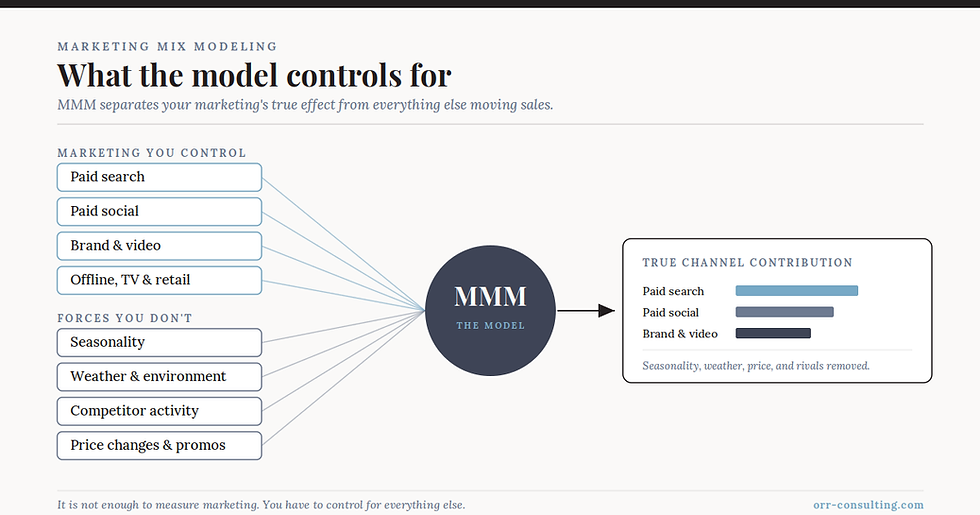
The output is not a click path. It is a decomposition. MMM splits your total sales into a baseline, the demand you would have captured with no marketing at all, and the incremental contribution layered on top by each channel. Once you can see that decomposition, the budget questions answer themselves. You know which channels are carrying real incremental weight, which ones are taking credit for demand that already existed, and where the next dollar is best spent.

2. Why MMM came back
MMM is not new. It has roots in econometrics going back decades, and for most of that time it lived inside large consumer packaged goods companies with the budgets to run it. What changed is the ground underneath digital attribution.
The model that powered the last decade of marketing, following a known user from impression to click to purchase, depended on stable identity. That identity layer has eroded. Browser tracking protections, mobile platform privacy controls, consent requirements, and the broad deprecation of third-party cookies have shrunk the share of the customer journey that user-level tools can actually see. When you can only observe a minority of conversions, fractional credit stops being measurement and turns into guesswork. MMM sidesteps the problem entirely, because it never needed to identify a single person in the first place. It reads aggregate cause and effect, which makes it durable no matter how the privacy rules shift next.
3. How the model works without the jargon
Two ideas do most of the heavy lifting in an MMM, and both reflect how marketing actually behaves.
The first is carryover, often called adstock. A television flight or a brand campaign does not spend its effect the day it runs. It lingers and decays over the following weeks. Paid search behaves almost the opposite way, with effect that lands fast and fades inside a week or two, while brand and video can carry over for two to three months. A credible model fits a different decay rate to each channel rather than pretending they all behave alike.
The second is diminishing returns, or saturation. The first dollars into a channel work hard. As you pour in more, each additional dollar buys less, until the channel flattens out. This is the curve that tells you a channel is not underperforming, it is simply full, and the money would do more somewhere else. A model that ignores saturation will tell you to keep feeding your best-looking channel long past the point where it has stopped paying you back.
Put carryover and saturation together across every channel, fit the model against your real sales history, and you get a quantified, comparable read on what each channel is genuinely worth.
4. MMM is not multi-touch attribution
This is the distinction I end up drawing most often, so it is worth being precise. Multi-touch attribution works from the bottom up. It tries to stitch together individual user journeys and assign fractional credit across the touchpoints each person saw. It is granular when the tracking holds, and it falls apart when the tracking does not.
Marketing mix modeling works from the top down. It correlates aggregate spend against aggregate outcomes and needs no personal data at all. It will never tell you that a specific customer saw three ads before buying, and that is the trade. What it gives you in return is a privacy-safe, board-ready view of channel contribution that holds up when the identity graph does not. The strongest measurement programs I build run both where the data supports it, and lean on MMM for the strategic budget calls.
5. When you actually need MMM
MMM is not the right tool for every business, and I will say so plainly to anyone who asks. If you run a single channel, or you are spending a few thousand dollars a month, the model will cost you more than the clarity is worth, and simpler testing will serve you better.
The brands that get real value sit roughly in the $5M to $50M range, run meaningful spend across four or more channels, and have at least two years of reasonably clean weekly history to model against. That combination is where the budget at stake is large enough to justify the work and the channel mix is complex enough that intuition and platform dashboards stop being trustworthy. If you are a growth-stage brand spending seven figures a year across paid, retail, and brand, and you cannot confidently say what would happen if you cut any one of them, you are the brand this was built for.
6. What a credible engagement looks like
The fastest way to waste money on MMM is to accept a number with no way to check it. A model that cannot be validated is a story with decimal places.
A real engagement starts with data you can trust, two to three years of weekly spend and outcome data plus the external drivers that move your category. It fits channel-specific carryover and saturation rather than one-size assumptions. And it proves itself before anyone reallocates a budget on its say-so, with model fit you can inspect, error rates held to single digits, and a holdout test that shows the model predicts periods it was not trained on. When it clears that bar, you do not just get a measurement. You get a planning tool that tells you where the next dollar should go.
If you are staring at dashboards that add up to more than the revenue you actually booked, that is the symptom MMM was built to cure. You can book a strategy call with me here: https://www.orr-consulting.com/bookamarketingstrategycall
Frequently asked questions
What is marketing mix modeling?
Marketing mix modeling is a statistical technique that uses aggregated historical data, your spend and activity by channel, your sales, and outside factors like seasonality and pricing, to estimate how much each marketing input contributes to revenue. It works at the level of the whole business rather than tracking individual users, which makes it privacy-safe by design.
How is MMM different from multi-touch attribution?
Multi-touch attribution works bottom up, stitching together individual user journeys and splitting credit across the touchpoints each person saw. It depends on user-level tracking. MMM works top down, correlating aggregate spend against aggregate outcomes with no personal data at all, so it stays reliable even as cookies and identity signals disappear.
How much historical data do you need for MMM?
A credible model wants at least two years of weekly data, and three is better. You need enough history for the model to see seasonality, promotions, and spend changes play out across channels. Less than two years and the model struggles to separate real channel effects from ordinary fluctuation.
How much does marketing mix modeling cost?
For a mid-market brand, a focused MMM engagement typically runs in the low five figures, with the exact figure depending on data readiness and the number of channels modeled. I scope it inside a deeper marketing audit so the model lands attached to a plan, not as a standalone report. Whatever you do, do not pay more than $50k for absolutely huge (Fortune 500 sized) budgets! For medium sized firms, never go over $25,000. Anything over these amounts are no less than fraud (although I see them all the time). You can see how I structure that here: https://www.orr-consulting.com/marketing-audits
Is MMM only for large companies?
Not anymore. It used to live inside large consumer packaged goods companies, but the privacy-driven collapse of user-level tracking brought it down market. Brands in the roughly $5M to $50M range with spend across four or more channels are now squarely in range, and open-source modeling has removed much of the old six-figure barrier to entry.
How accurate is marketing mix modeling?
A well-built model should be validated before anyone trusts it. That means strong model fit, prediction error held to single digits, and a holdout test proving the model predicts periods it was not trained on. If a vendor cannot show you those checks, treat the numbers as a story rather than a measurement. There is a common expressions in stats: GIGO: Garbage in, Garbage out. Any statistician can make data say anything they want it to say. Make sure your statistician knows how to properly build the models AND how to properly analyze them.
Find out what your channels are actually worth
If you are running real budget across more than a few channels and cannot say with confidence what would happen if you cut any one of them, that is the gap marketing mix modeling closes. I scope MMM inside a deeper marketing audit so the model arrives attached to a plan, not as a standalone report you have to interpret on your own.
You can see how I build that work on the marketing mix modeling and analytics page, see where it sits in the marketing audit tiers, or skip ahead and book a strategy call and we will figure out whether your data is ready for it.


Comments