


Marketing Mix Modeling vs. Attribution: Why Most Marketing Measurement Is Wrong (And It's Costing Companies Millions)

The Marketing Industry Has a Measurement Problem
For decades, marketers have been asking the same question:
"Which marketing channel generated this sale?"

At first glance, it seems like the right question. In fact, it's the foundation of almost every marketing dashboard you've ever seen. Agencies build reports around it. Software companies sell platforms that promise to answer it. Executive teams review it every month before deciding where to spend next quarter's budget.
There's just one problem.
It's the wrong question.
Customers don't buy because of a single advertisement. They don't wake up one morning, click a Google ad, and suddenly decide to spend thousands of dollars because of one well-written headline.
Purchasing decisions are rarely that simple.
Instead, confidence builds gradually. Every interaction with your brand adds another piece to the puzzle. A customer may hear about your company on a podcast, read an article featuring your CEO, notice your brand repeatedly on LinkedIn, receive a recommendation from a colleague, browse your website several times, and only weeks later perform a Google search before finally becoming a customer.
Which one of those interactions caused the sale?
The honest answer is that they all contributed.
Marketing doesn't work as a series of isolated events. It works as a system. Every campaign, every customer interaction, every earned media mention, every conversation with a salesperson, every review, every email, and every advertisement influences what happens next.
Yet somewhere along the way, the marketing industry became obsessed with identifying a single winner.
We became so focused on assigning credit that we stopped asking a much more important question:
What actually caused the business to grow?
Those are not the same thing.
One is about assigning credit.
The other is about understanding cause and effect.
If your goal is simply to produce attractive reports, attribution can be incredibly satisfying.
If your goal is to make smarter multimillion-dollar investment decisions, the conversation becomes far more complicated.
Because business growth is rarely the result of one channel succeeding. More often, it's the result of multiple channels working together over time, each influencing the next until a prospect finally becomes confident enough to buy.
Understanding that difference is where great marketing leaders separate themselves from good campaign managers.
The Last Click Lie
One of the biggest mistakes modern marketing has made is confusing the last measurable interaction with the most influential interaction.
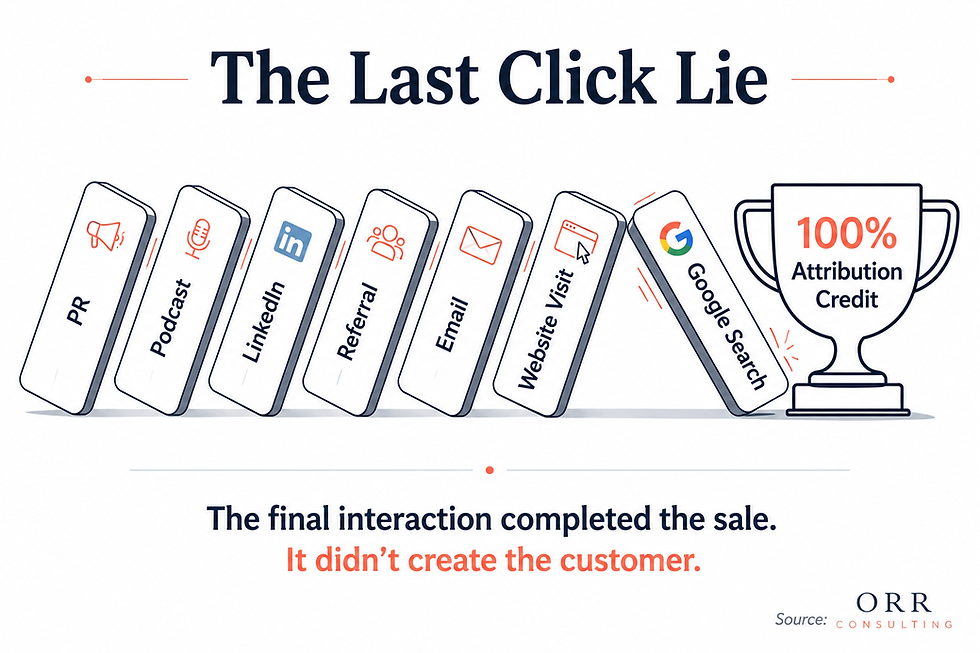
They're almost never the same thing.
Attribution has trained an entire generation of marketers to celebrate whatever happened immediately before a conversion.
Someone searched your brand on Google?
Google gets the credit.
Someone clicked an email?
Email gets the credit.
Someone came directly to your website?
Direct traffic gets the credit.
It creates the comforting illusion that buying decisions happen in neat, measurable moments.
Real customers don't behave that way.
They gather information. They compare alternatives. They ask colleagues for recommendations. They read reviews. They see your advertising repeatedly over weeks or months. Their confidence grows a little with every interaction until eventually making a purchase feels less like taking a risk and more like making the obvious decision.
By the time someone submits a lead form or places an order, the decision has often been made long before the final click ever occurred.
Here's an analogy I often use.
Imagine walking into a Broadway theater during the final two minutes of a performance. The audience rises for a standing ovation just as the lead actor delivers the closing line.
If all you witnessed was the ending, you might reasonably conclude that the actor speaking at that moment deserved all the credit for the applause.
Of course, that would be absurd.
The standing ovation belongs to everyone who contributed to the performance. The playwright who crafted the story. The director who shaped it. The supporting cast who built the emotional tension. The musicians, lighting designers, stage crew, costume designers, and producers who made the experience possible.
The final line simply happened to occur at the moment the audience stood up.
Marketing attribution often makes the same mistake.
It rewards the final interaction because that's the easiest one to measure, not because it was the one that created demand.
In fact, some of the channels that attribution consistently rewards are actually harvesting demand that was created elsewhere.
Branded Google searches are a perfect example.
People rarely search your company's name without first hearing about you somewhere else. That awareness may have come from public relations, influencer marketing, podcasts, conference presentations, referrals, social media, television, or months of educational content.
Yet because branded search happened to be the final measurable interaction, it often receives nearly all the credit.
That's like giving the cashier credit for every customer who walks into the store while ignoring the advertising, merchandising, pricing, customer service, and product quality that convinced them to come in the first place.
The cashier completed the transaction.
The business created the customer.
Marketing measurement should recognize the difference.
The Walled Garden Problem
Even if attribution models were perfect—and they aren't—modern marketing faces another challenge that many executives don't fully appreciate.

The companies collecting the data don't actually have access to the complete customer journey.
Google knows an extraordinary amount about what happens inside Google's ecosystem.
Meta knows an extraordinary amount about Facebook and Instagram.
Amazon understands Amazon.
LinkedIn understands LinkedIn.
TikTok understands TikTok.
Each platform has become what marketers refer to as a walled garden: an ecosystem with incredibly rich internal data but very limited visibility into what happens outside its own walls.
That isn't because these companies are trying to hide information from one another.
It's because they simply don't have it.
Google cannot see the conversation your prospect had with a colleague over lunch.
Meta doesn't know someone attended your webinar two weeks earlier.
LinkedIn has no idea your CEO was interviewed on an industry podcast that inspired someone to search for your company.
None of these platforms knows whether a customer first discovered your brand through public relations, a trade show, a billboard, an influencer, a television interview, or a referral.
They only know what happened once that customer entered their own ecosystem.
This distinction matters because every advertising platform is reporting from a different window into the same customer journey.
Imagine trying to understand an entire football game while sitting in a stadium with one section of the field permanently blocked from view. You'd still see plenty of action, but you'd never see the complete game.
That's exactly how marketing platforms work.
Google isn't lying to you.
Meta isn't lying to you.
Your CRM isn't lying to you.
They're all reporting accurately based on the information they have available.
The problem is that none of them has all the information.
That's why it's entirely possible for Google Ads, Meta Ads, your email platform, and your CRM to all claim responsibility for the same customer.
Each system is measuring its own portion of the journey.
None of them is measuring the entire journey.
And that's precisely why organizations that rely exclusively on attribution eventually hit a ceiling. They're making strategic decisions based on fragmented views of customer behavior instead of understanding how all of their marketing investments work together to create incremental business growth.
Attribution vs. Marketing Mix Modeling
By this point, many executives assume the solution is to collect more data.
It isn't.
Most organizations already have more marketing data than they know what to do with.
They have Google Analytics. CRM reports. Google Ads dashboards. Meta Ads dashboards. Call tracking. Shopify reports. Email marketing analytics. Sales reports. Marketing automation platforms. Business intelligence dashboards. Some even have customer data platforms pulling everything together into a single interface.
None of those tools is inherently flawed.
In fact, many of them are exceptionally good at measuring what happens within their own environment.
The problem is that adding another dashboard rarely answers the question executives actually care about.
Where should we invest the next marketing dollar?
I've never walked into a company and thought, "The problem is they don't have enough reports."
I've walked into plenty of organizations with a dozen dashboards covering every imaginable marketing metric that still couldn't answer a simple executive question.
"If we reduce our Google Ads budget by $250,000 next year and invest that money in brand awareness, public relations, or influencer marketing, what happens to revenue?"
None of the dashboards could answer it.
Because they weren't designed to.
Marketing leaders don't suffer from a shortage of information.
They suffer from a shortage of insight.
There's an enormous difference.
Information tells you what happened.
Insight helps you decide what to do next.
That's where Marketing Mix Modeling fundamentally changes the conversation.

Marketing Mix Modeling Asks a Different Question
One of the biggest misconceptions about Marketing Mix Modeling is that it's simply another attribution model.
It isn't.
In fact, it's solving an entirely different problem.
Traditional attribution asks:
Which marketing touchpoint received credit for this customer?
Marketing Mix Modeling asks:
What factors actually changed business performance?
That distinction may sound subtle, but it changes everything.
Instead of following one customer's journey through a website, Marketing Mix Modeling looks at the business as a whole.
It analyzes historical marketing investments alongside business outcomes and asks a much larger question:
What combination of factors best explains changes in revenue over time?
That means Marketing Mix Modeling doesn't just evaluate paid search or paid social.
It can account for factors such as:
Public relations
Influencer marketing
Television
Radio
Podcast sponsorships
Trade shows
Direct mail
Organic search
Email marketing
Pricing changes
Promotional activity
Distribution
Seasonality
Competitive spending
Economic conditions
Weather
Consumer confidence
In the real world, customers don't separate these influences.
Neither should your measurement strategy.

Stop Saying PR Can't Be Measured
This is probably the statement I hear most often from executives.
"We love our PR agency, but we just can't measure what they're do."
I disagree.
What most people really mean is this:
"We can't measure PR using attribution software."
Those are two very different statements.
Public relations influences awareness.
Executive thought leadership builds credibility.
Podcast interviews generate branded search.
Conference presentations create trust.
Influencers introduce brands to entirely new audiences.
None of those activities necessarily produces an immediate click.
But that doesn't mean they aren't creating measurable business value.
In many industries, they are creating the demand that every other marketing channel eventually captures.
If a CEO is interviewed on a nationally recognized podcast and branded search volume increases for the next six months, did the podcast matter?
If a public relations campaign results in higher direct website traffic, more branded Google searches, stronger conversion rates, and increased sales, did PR influence revenue?
Of course it did.
The mistake isn't investing in those channels.
The mistake is expecting Google Analytics to tell you their value.
That's asking the wrong tool to solve the wrong problem.
Marketing Mix Modeling was developed precisely because many of the activities that create business growth cannot be evaluated through click-based attribution alone.
Think Like an Economist, Not Just a Marketer
Marketing Mix Modeling has its roots in econometrics rather than advertising technology.
That distinction matters.
Instead of attempting to reconstruct every individual customer's path to purchase, econometric models examine patterns across thousands—or even millions—of observations.
Imagine looking at three years of business performance.
Every advertising campaign.
Every pricing change.
Every promotional period.
Seasonality.
Competitor activity.
Website redesigns.
Email campaigns.
Public relations.
Influencer partnerships.
Economic indicators.
Weather events.
Product launches.
Now imagine asking a statistical model one simple question:
Which combination of these variables best explains the changes we observed in sales?
That's Marketing Mix Modeling.
It isn't trying to identify who received the last click.
It's trying to understand what actually changed business performance.
That's a fundamentally different objective.
The Dirty Little Secret About Marketing Mix Modeling
As Marketing Mix Modeling has become more popular, software vendors have rushed to make it more accessible.
That's a good thing.
Today there are excellent tools available from companies such as Google, Meta, and a growing number of analytics providers that can dramatically reduce the technical effort required to build sophisticated models.
But software doesn't replace expertise.
Buying Marketing Mix Modeling software no more makes someone an econometrician than buying Excel makes someone a statistician.
The software produces outputs.
Someone still has to determine whether the model is statistically valid.
Someone has to account for multicollinearity, diminishing returns, carryover effects, adstock, seasonality, omitted variable bias, and changing market conditions.
More importantly, someone has to translate statistical findings into executive decisions.
The CEO doesn't care about regression coefficients.
The CEO wants to know:
"Where should we invest next year's marketing budget?"
That's where experience matters.
A Marketing Mix Model doesn't make decisions.
People do.
Attribution Isn't Dead. It's Just Being Asked to Do Too Much.
At this point, you might think I'm arguing that attribution should be abandoned.
I'm not.
Attribution remains one of the most valuable tools available for tactical marketing optimization.
It's excellent for evaluating creative performance, testing landing pages, optimizing keywords, improving bidding strategies, and understanding user behavior within individual platforms.
Those are incredibly important activities.
The mistake is asking attribution to answer strategic questions it was never designed to answer.
Questions like:
Which marketing channels are driving incremental growth?
Have we reached diminishing returns in paid search?
Is public relations increasing long-term demand?
Should we shift budget from Meta to television?
What's the true return on our sponsorship strategy?
Those aren't attribution questions.
They're executive business questions.
And they require executive-level measurement.
The Future of Marketing Measurement
The future isn't Marketing Mix Modeling replacing attribution.
It's Marketing Mix Modeling working alongside attribution, incrementality testing, experimentation, artificial intelligence, and experienced strategic leadership.
Each tool answers a different question.
The organizations that outperform their competitors won't necessarily be the ones with the biggest marketing budgets or the most sophisticated dashboards.
They'll be the ones that understand how to use the right measurement approach for the right decision.
That's an important distinction.
Because the goal of marketing measurement isn't to build prettier reports.
It's to make better business decisions.
Final Thoughts
Every marketing leader wants certainty.
Unfortunately, certainty doesn't exist.
Marketing will always involve uncertainty because people are wonderfully unpredictable.
What does exist is better evidence.
Attribution gives you one piece of that evidence.
Marketing Mix Modeling gives you another.
Experience tells you how to use both.
The companies that consistently outperform their competitors over the next decade won't win because they tracked more clicks or built more dashboards.
They'll win because they asked better questions, understood the limitations of their data, and made smarter decisions about where to invest their next marketing dollar.
If you're still measuring success primarily by the last click, you're optimizing yesterday's marketing strategy.
If you're ready to understand what is actually driving business growth, it's time to start measuring marketing differently. Schedule a call now if you need a marketing audit, MMM, or other support.
Frequently Asked Questions About Marketing Mix Modeling
What is Marketing Mix Modeling (MMM)?
Marketing Mix Modeling (MMM) is a statistical analysis technique that measures how different marketing activities contribute to business outcomes such as revenue, sales, leads, or profit. Rather than tracking individual customer clicks, MMM analyzes historical business data to determine how marketing investments, pricing, promotions, seasonality, competitive activity, and external factors work together to influence performance.
Unlike attribution models, Marketing Mix Modeling is designed to answer strategic questions about budget allocation and long-term marketing effectiveness.
What's the difference between Marketing Mix Modeling and attribution?
Attribution and Marketing Mix Modeling answer different questions.
Attribution attempts to assign credit for an individual conversion based on customer interactions, such as a Google search, an email click, or a social media ad.
Marketing Mix Modeling evaluates the overall impact of your marketing investments on business performance over time. Instead of asking, "Which ad got the click?" it asks,
"Which marketing activities actually drove incremental business growth?"
The two approaches complement one another. Attribution is valuable for optimizing campaigns, while Marketing Mix Modeling supports executive decisions about budgeting, forecasting, and long-term strategy.
Can Marketing Mix Modeling measure PR and influencer marketing?
Yes—and this is one of its greatest strengths.
Many organizations assume that public relations, executive thought leadership, podcast appearances, influencer marketing, sponsorships, and other awareness-building activities cannot be measured.
The reality is they often can't be measured accurately through click-based attribution.
Marketing Mix Modeling was specifically developed to evaluate marketing activities that influence customer behavior without generating an immediate or directly trackable click. While no measurement method is perfect, MMM can quantify the contribution of these channels far more effectively than traditional attribution models.
Does Marketing Mix Modeling replace Google Analytics or GA4?
No.
Google Analytics, GA4, and other attribution platforms remain valuable tools.
They provide insights into user behavior, website performance, conversion paths, landing page effectiveness, and campaign optimization.
Marketing Mix Modeling serves a different purpose.
Think of attribution as helping your marketing team optimize campaigns, while Marketing Mix Modeling helps executives decide how to allocate next year's marketing budget.
Most mature organizations benefit from using both approaches together.
When should a company invest in Marketing Mix Modeling?
Marketing Mix Modeling becomes increasingly valuable when:
Your marketing budget reaches six or seven figures.
You're investing across multiple marketing channels.
You use both online and offline marketing.
Customer journeys span weeks or months.
Leadership needs confidence in budget allocation decisions.
You want to understand true marketing ROI rather than platform-reported performance.
If your organization is asking strategic questions about where to invest the next marketing dollar, Marketing Mix Modeling is often the right next step.
Is Marketing Mix Modeling only for large enterprise companies?
Not anymore.
Historically, Marketing Mix Modeling was reserved for Fortune 500 companies because it required significant amounts of data and specialized statistical expertise.
Today, advances in cloud computing, AI-assisted analytics, and modern modeling techniques have made Marketing Mix Modeling accessible to many mid-sized organizations.
The key question isn't company size—it's complexity.
If you're marketing across multiple channels and making meaningful budget decisions, you can likely benefit from Marketing Mix Modeling.
How much data is needed for Marketing Mix Modeling?
The answer depends on the complexity of your business and the questions you're trying to answer.
In general, Marketing Mix Modeling performs best when organizations have consistent historical data across marketing channels, sales performance, and external business factors over an extended period.
The quality and consistency of the data are often more important than the sheer volume.
An experienced Marketing Mix Modeling consultant can assess whether your existing data is sufficient and identify any gaps before building a model.
Does AI eliminate the need for Marketing Mix Modeling?
No.
Artificial intelligence is making Marketing Mix Modeling faster and more accessible, but it doesn't replace it.
AI can help clean data, identify patterns, build models, and accelerate analysis. It can even automate parts of the modeling process.
However, AI still depends on sound statistical methodology, high-quality data, and thoughtful interpretation.
Business leaders don't need more algorithms.
They need better decisions.
AI is an incredibly valuable tool, but it should enhance human expertise—not replace it.
How often should Marketing Mix Models be updated?
There isn't a single answer for every organization.
Many companies refresh their models annually as part of strategic planning and budget development.
Organizations operating in rapidly changing markets or investing heavily in advertising may update their models quarterly or semi-annually.
The right cadence depends on factors such as market volatility, advertising spend, seasonality, and how frequently your marketing strategy changes.
How can a Fractional CMO help with Marketing Mix Modeling?
Building the model is only one part of the process.
The real value comes from translating statistical findings into business strategy.
A Fractional CMO helps bridge that gap by interpreting the results, identifying opportunities, prioritizing investments, and turning analytical insights into actionable marketing decisions.
The goal isn't simply to produce a sophisticated model.
The goal is to make smarter, evidence-based decisions that improve marketing performance, increase ROI, and support long-term business growth.


Comments