


I Audited Hundreds of Marketing Programs. These Are the 25 Most Common Reasons Companies Stop Growing.

The conversation almost always starts the same way.
Revenue flattened somewhere around three quarters ago. Lead volume still looks acceptable on the dashboard, but sales insists the leads have gotten worse. Acquisition costs have crept up every quarter for two years and nobody can point to the quarter it started. Marketing meetings have quietly turned into a monthly exercise in explaining why the next month will be better.
By the time someone calls me, the leadership team has usually landed on an explanation. We need more traffic.
In my experience that is almost never the constraint.
I have spent more than two decades evaluating marketing performance across healthcare, professional services, e-commerce, SaaS, consumer products, and B2B organizations, first as a tenured marketing professor and then across more than a hundred consulting engagements. Companies rarely stop growing because of one catastrophic mistake. Growth slows because dozens of small inefficiencies accumulate until the entire system stops converting effort into revenue.
The encouraging part is that nearly all of them are visible during a structured marketing audit.
Here are the 25 issues I find most often.
1. Does your company still have a clear positioning statement?
Most companies I audit cannot articulate one in a sentence. Organizations evolve while their messaging stays frozen at whatever was true five years ago, and the result is convergence. Gartner has found that 64 percent of B2B customers cannot distinguish one brand's digital experience from another's, which pushes undifferentiated companies straight into price competition. Dentsu research put the perception gap even more starkly: 71 percent of B2B marketers believe they communicate a distinct position, while 68 percent of buyers say brands roughly act and sound the same. If a competitor could paste your homepage copy onto their site and nobody would notice, positioning is your growth problem.
2. Are your marketing decisions starting with channels?
Channel questions are tactical questions wearing strategic clothing. Should we do TikTok, should we increase Google Ads, should we start a podcast. The 35th edition of
The CMO Survey, fielded in January 2026, found that more than half of companies increased the number of channels they use, adding digital, social, retail media, and face-to-face in parallel, even as their growth strategies stayed narrowly focused on existing products in existing markets. Adding surface area is easier than deciding what you are actually trying to win. Strategy should determine the channel list, and that sequence gets reversed constantly.
3. Does anyone in the building actually understand the current customer?
Customer understanding decays faster than most teams realize. Markets shift, competitors reposition, and expectations reset, yet plenty of companies are still marketing to the buyer they had in 2020. The CMO Survey found that rather than investing in deeper customer insight, most marketers are focusing on stronger performance tracking as their primary way to demonstrate value. Measuring the customer you no longer have is a very precise way to be wrong.
4. Does every department define a qualified lead the same way?
Marketing celebrates MQLs, sales complains about lead quality, and leadership wonders why revenue is flat. Forrester found that 82 percent of C-level executives believe their sales and marketing teams are aligned while 65 percent of the frontline professionals in those same organizations report a lack of alignment. That perception gap is where lead definitions live. When success is defined three different ways, nobody can optimize the system, and everyone can defend their own numbers.
5. How much of your demand comes from a single channel?
Concentration risk stays invisible until the channel moves. The AI referral landscape makes the point efficiently: Similarweb data shows ChatGPT's share of generative AI web traffic falling from roughly 76 percent in mid 2025 to about 53 percent by May 2026, a redistribution that happened in under a year. Google's algorithm, Meta's auction dynamics, and referral partners all move on similar timelines. Companies that depend on one source of demand usually discover the exposure the month after performance drops.
6. Does your website persuade or only explain?
Most websites answer questions competently and convince almost nobody. That matters more now that buyers arrive already leaning. Forrester's research found that 48 percent of first-time B2B buyers enter the process with a preferred vendor in mind, and 63 percent of solo decision-makers begin with a single vendor already selected. Your site is not introducing you to a blank slate. It is either reducing uncertainty and building confidence or it is confirming that the buyer was right to prefer someone else.
7. Is your homepage trying to say everything at once?
Homepages accumulate. Every stakeholder adds a priority, every product line requests representation, and the page ends up saying nothing with total thoroughness. Research from Ipsos and JKR tested 5,046 brand assets across 523 brands with more than 26,000 respondents globally and found that only 15 percent achieved gold standard distinctiveness, meaning assets that immediately and uniquely brought the brand to mind. When everything on the page is important, nothing on the page is memorable.
8. Are you measuring marketing activity or business outcomes?
Followers, clicks, impressions, and likes are inputs that feel like results. Nielsen's 2025 Annual Marketing Report, based on 1,400 global marketing professionals, found that 85 percent of marketers feel confident they are tracking holistic performance while only 32 percent actually measure spend across both digital and traditional channels. That 53 point gap between confidence and capability is where most reporting problems live. Revenue pays salaries, and activity metrics rarely correlate with it as tightly as dashboards imply.
9. Can your analytics answer basic business questions?
Which campaigns produce the highest lifetime value customers. Which channels generate profit rather than volume. What actually caused this sale. Most analytics implementations cannot answer any of the three. Speero's audits of more than 150 experimentation teams found that roughly 90 percent of the analytics setups they analyzed were critically flawed, producing unreliable data regardless of how sophisticated the testing program sitting on top of it was. When reporting cannot answer business questions, optimization becomes guesswork with a spreadsheet attached.
10. Are you mistaking attribution for causation?
The last click completed a journey that many other touchpoints created. Dreamdata's 2026 analysis of 3.5 million complete B2B customer journeys found the average buying process now spans 272 days, 88 touchpoints, four channels, and ten stakeholders, up sharply from 211 days and 76 touchpoints just two years earlier. The same research found that 81 percent of the buyer journey happens before a lead ever enters the sales pipeline. Assigning credit to the final interaction systematically defunds everything that made the final interaction possible, which is why marketing mix modeling and incrementality testing have come back into serious use.
11. Is paid advertising compensating for weak positioning?
Budget does not fix unclear messaging. It buys wider distribution for unclear messaging, and the market charges you for the privilege. SimplicityDX research found that customer acquisition costs rose 222 percent over eight years, with the average e-commerce brand now losing about 29 dollars on every new customer acquired, compared with a 19 dollar profit a decade earlier. Meanwhile Gartner's 2025 CMO Spend Survey found paid media consuming 30.6 percent of marketing budgets, the largest single line. Paying more for media is the most expensive way to avoid a positioning conversation.
12. Is your SEO producing traffic or buyers?
Ranking is a means to revenue, and a lot of rankings no longer produce even a click. SparkToro's 2026 clickstream analysis found that fewer than one third of Google searches now send a click to any destination, with the share of searches generating at least one click falling 9.51 percentage points between 2024 and 2026. Ahrefs measured a 58 percent drop in position one click-through rate when an AI Overview is present.
Thousands of visitors consuming educational content will not outperform a handful of decision-makers searching with commercial intent, and the informational traffic is exactly what is disappearing.
13. Do marketing and sales operate as one revenue system?
One team creates demand and the other converts it, and in most organizations they operate on separate calendars with separate definitions of success. The waste is measurable. Research consistently finds that 60 to 70 percent of B2B marketing content goes unused by sales teams while 65 percent of sales reps report they cannot find the content they need. McKinsey found acquisition costs increase by as much as 36 percent when marketing processes are not harmonized with sales. Both functions get less effective in isolation, and the cost shows up in CAC.
14. Are you visible inside AI answer engines?
Buyers increasingly build their shortlist inside ChatGPT, Google AI Overviews, Perplexity, Claude, and Gemini before they ever open a traditional search results page. The CMO Survey found that generative engine optimization is already in use at four in ten companies, a capability that did not appear in any previous edition of the survey.
Similarweb found that brands appearing in ChatGPT recommendations were 2.5 times more likely to receive a site visit within seven days than brands that were not recommended. The volume is still small relative to organic search, and the intent quality is high. Absence from those conversations is invisible in your analytics, which is precisely what makes it dangerous.
15. Is your pricing communicating the wrong message?
Price is a positioning signal before it is a revenue lever. The classic McKinsey analysis found that a 1 percent price increase produces roughly an 8 percent lift in operating profit when volume holds, which makes pricing the highest leverage variable most companies leave untouched. Simon-Kucher's 2025 global study of 2,200 business leaders across 28 countries found companies are realizing only about half of their planned price increases. In premium and expertise-driven categories, raising price sometimes improves conversion because buyers read price as a proxy for capability.
16. Are marketing decisions being made on opinion?
The loudest voice wins, or the highest paid executive wins, or the founder wins. Optimizely's analysis of more than 127,000 experiments found that only about 12 percent of test ideas produce a statistically significant positive result. Read that number carefully. It means the large majority of confident improvements that teams ship without testing are doing nothing measurable, and a meaningful share are doing harm. Experience is valuable for generating hypotheses and unreliable for validating them.
17. Do your campaigns launch with a testing framework?
Testing should be designed to answer a business question rather than to satisfy curiosity. Very few companies get this far. BuiltWith data suggests roughly 0.2 percent of active websites are running structured experiments at all, and Kameleoon's 2025 research found that 65 percent of businesses that do run experiments have not fully integrated their testing technology, which confines them to page-level tweaks. Random testing produces random learning. Structured testing compounds.
18. How much attention does retention actually get?
Retention is where the profit is, and budgets rarely reflect it. The CMO Survey found that acquisition budgets remain 26 percent larger than retention budgets, even though the same survey identified customer retention as the strongest performance driver in 2026, outpacing both acquisition and brand value. Frederick Reichheld's original Bain research established that a 5 percent improvement in retention produces a 25 percent or greater increase in profit. Nearly half of marketers now say they are prioritizing retention, and the spending has not followed the stated priority.
19. Is your brand consistent across every channel?
Different messaging, different visuals, different promises, all from the same company.
Customers should never have to work out whether they are dealing with the same organization. The commonly cited estimate is that consistent brand presentation lifts revenue somewhere in the range of 23 to 33 percent, though that figure comes from self-reported survey data and I would treat it as directional rather than precise. The more useful statistic is the execution gap: roughly 95 percent of organizations have brand guidelines and only about 30 percent use them regularly. Consistency is a governance problem long before it is a creative one.
20. Is your marketing calendar a plan or an emergency queue?
Reactive organizations fill their calendars with urgency and mistake it for momentum. The CMO Survey found that more than 70 percent of marketers report prioritizing immediate results over long-term gains, often falling back on established tactics rather than new investment. The same research found that the median duration of marketing impact on customers has lengthened to six months, with a meaningful shift toward a year or longer. Companies are optimizing for a time horizon shorter than the one their own marketing operates on.
21. Are marketing budgets connected to financial goals?
Budgets should be built from revenue objectives rather than from last year's number adjusted for inflation. The CMO Survey found marketing budgets have declined to 9.0 percent of company revenues with overall spending growth slowing to 1.7 percent, the weakest rate in several years, and that collaboration between marketing and finance remains limited with the CMO and CFO partnership improving only marginally. When marketing cannot speak in the finance function's language, marketing becomes the easiest line item to cut when performance softens.
22. Is leadership expecting marketing to fix business problems?
Marketing amplifies whatever is already true about the business. It cannot compensate for a weak product, poor customer service, broken operations, or a sales process that loses qualified buyers. I see this most often when a company has spent two years increasing marketing investment against a retention problem. The CMO Survey's finding that retention now outperforms acquisition and brand value as a driver of company performance is a useful reminder that the leak matters more than the inflow.
23. Is your team documenting what works?
High-performing campaigns get repeated without anyone understanding the mechanism, so when performance eventually degrades nobody knows which variable moved. The institutional memory walks out with whoever ran it. The CMO Survey found that how companies build marketing capability has barely changed since 2020, with more than 60 percent developing capabilities internally, while training budgets have fallen to 3.8 percent of marketing spend and headcount growth dropped by half in a single year. Learning that is not documented is learning that has to be purchased twice.
24. Who owns the entire customer journey?
Different teams own different segments and no single person owns the experience from awareness through advocacy. With a typical B2B purchase now involving ten stakeholders across 88 touchpoints, the handoff points multiply faster than anyone's mandate. Customers experience one company. Your organizational chart is not their problem, and they will judge the weakest handoff as though it were deliberate.
25. When was the last time anyone audited the marketing system?
Every business audits its finances. Many audit cybersecurity. Some audit operations.
Very few audit marketing with anything like the same discipline, which is remarkable given that marketing is often the second largest controllable expense on the P&L.
Markets evolve, competitors reposition, technology resets, and consumer behavior shifts. A system that has not been evaluated in three years is being run on assumptions that expired.
The pattern I see most often
Companies almost never have just one of these issues. Most organizations with stalled growth have five to ten operating simultaneously, and they reinforce each other.
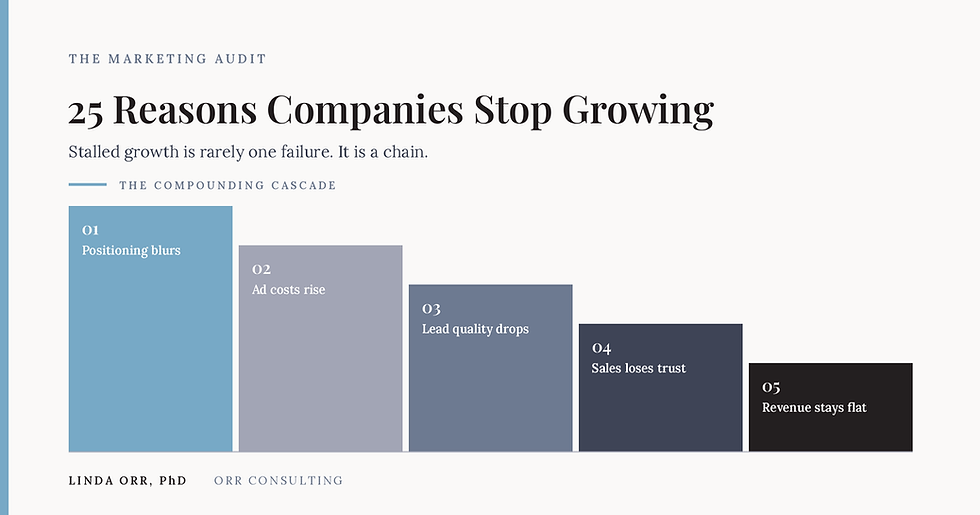
Weak positioning raises advertising costs. Higher advertising costs reduce lead volume at the same budget. Lower lead volume pressures marketing to chase cheaper, less qualified traffic. That traffic converts poorly, which causes sales to distrust marketing, which causes leadership to demand more campaigns rather than a strategy conversation. Six quarters later the company has three times the activity and the same revenue.
The symptoms look unrelated. The root cause usually is not.
This is why increasing ad spend, redesigning the website, or launching another campaign so often fails to restore growth. Those interventions treat symptoms that are downstream of a constraint nobody has named.
Growth leaves clues
The purpose of a marketing audit is not to criticize what has been built. It is to locate where the system is leaking revenue, where opportunities are being missed, and where the next dollar produces the highest return.
Every stalled company has constraints. The work is identifying the right ones, in the right order, and resisting the urge to fix the visible problem before you have found the causal one.
If growth has slowed despite continued marketing investment, the issue may not be effort. It may be the system.
Common questions about marketing audits
What is a marketing audit?
A marketing audit is a structured evaluation of the entire marketing system measured against business outcomes. It examines strategy, positioning, customer acquisition, analytics and measurement, conversion, paid media, SEO, AI visibility, CRM, and the full customer journey as one connected system rather than as a series of separate channel reviews. The output is a ranked set of constraints ordered by revenue impact, so leadership knows which few changes matter most and in what sequence.
How do I know whether my problem is positioning or a channel problem?
Positioning problems show up as rising costs across every channel at the same time. If acquisition cost is climbing in paid search, paid social, and organic simultaneously, no single channel change caused it and no channel tactic will resolve it. Channel problems are isolated and usually traceable to a specific shift in platform behavior, creative fatigue, or auction dynamics. When performance degrades everywhere on the same timeline, the message is the variable worth examining first.
How long does a marketing audit take?
Most audits run three to six weeks depending on data availability and organizational complexity. The largest variable is measurement quality. When analytics are properly instrumented, the diagnostic work moves quickly. When tracking has to be validated or rebuilt before anything can be trusted, the timeline extends. Companies that cannot answer basic revenue questions from their own reporting should plan for the longer end.
How often should a company audit its marketing?
Annually for most companies, and immediately after any material change to the business. An acquisition, a leadership transition, a repositioning, a new product line, or a significant channel shift each invalidate the assumptions the previous plan was built on. Given how quickly search behavior and AI discovery have moved in the past two years, a marketing system that has not been evaluated since 2024 is operating on expired inputs.
Can a marketing audit fix declining revenue?
An audit produces the diagnosis and the priority order, and revenue moves when the recommendations get implemented. The value is in the sequencing. Most companies with stalled growth have already tried several fixes, and what they lack is confidence about which constraint is actually binding. Knowing that prevents another year and another budget cycle spent improving something that was never the limiting factor.
Ready for an objective assessment?
If your company is experiencing slowing growth, rising acquisition costs, declining lead quality, or inconsistent performance across channels, an independent evaluation is usually the fastest way to find out why.
At Orr Consulting I conduct comprehensive marketing audits covering strategy, positioning, customer acquisition, analytics and measurement, conversion, paid media, SEO, AI visibility, CRM, and the full customer journey. The goal is not a longer list of tactics. It is identifying the few changes that will move revenue and profitability the most.
Schedule a discovery call to talk through where your growth is stalling and whether a strategic marketing audit is the right next step.
Sources
The CMO Survey, 35th edition, Duke University Fuqua School of Business, Deloitte, and the American Marketing Association, January 2026
Gartner 2025 CMO Spend Survey
Nielsen 2025 Annual Marketing Report
Forrester, B2B Sales and Marketing Alignment research and B2B Buyers Journey Survey
Dreamdata, B2B Benchmarks Report, March 2026
SparkToro and Datos, Zero-Click Search Study, 2026
Ahrefs, AI Overviews CTR analysis, February 2026
Similarweb, Generative AI traffic and referral research, 2026
SimplicityDX, The Customer Acquisition Crisis
Optimizely, analysis of 127,000+ experiments
Ipsos and JKR, brand distinctiveness study
Dentsu, B2B differentiation research, 2024
Simon-Kucher Global Pricing Study, 2025
McKinsey, The Power of Pricing (Marn and Rosiello)
Bain & Company, Frederick Reichheld retention research


Comments